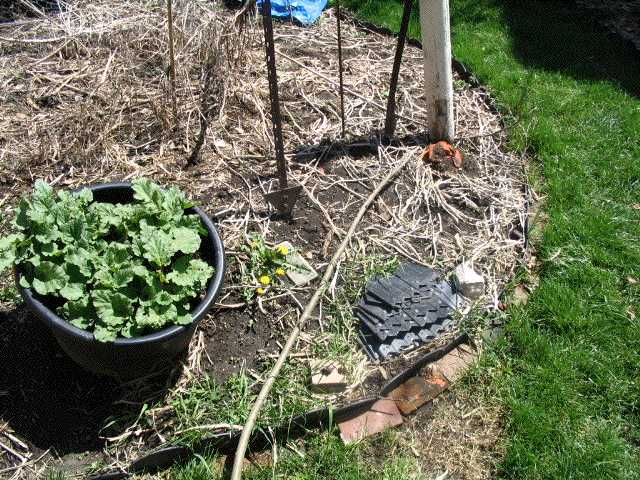
 Today was glorious day – an abrupt and shocking change from the cold rain during the week. We decided to address the one corner of our large, round planting bed that hadn’t been entirely destroyed during construction. The northern half will require some recovery work but this little corner requires only surface reclamation. We wanted to get as much of it done in 20 minutes as possible so we could go off and enjoy a bit of that sunshine in other ways.
The Plan: Snow Peas and pole beans. We chose beans and peas because they can tolerate cold soil. In fact, I think that peas really enjoy cool soil so our only chance at them comes early in the season. They also do particularly well if inoculated with “rhizobial bacteria” It’s also good for garden peas, sweets peas, beans, lima beans cowpeas and peanuts. This is one of those fascinating bits of biological teamwork between some microbes (I think Rhizobium leguminosarum vicaeo and phaseoli and bradyrhizobium) and the roots of the above mentioned plants. Together, the plants and bacteria work especially well to take nitrogen from the atmosphere and change it into the kind of “fixed” nitrogen that plants use. We try to move the beans around from year to year to let them add that nitrogen to other areas. But I’ve heard that if you continually grown beans or peas in a certain area that you’ve inoculated with rhizobial bacteria that the bacteria will continue to live there year after year.
The particular varieties we planted this year were “Oregon Sugar Pod” snow peas (from Burpee Organic) and “Kentucky Wonder” pole beans (from the organically grown “Source of Nature line from Ferry-Morse.) Since the beans expired in 2004 and the Peas in 2005, we just sowed them extra thickly. (Don’t worry. We’re not fanatically organic. Just what you could call “pragmatically organic.” I’ll get around to explaining that at some point.)
The Work: Our big round planting bed is usually divided into 12 evenly sized pie-wedge shaped areas. We figured we could get one of them planted up in 20 minutes.
I didn’t till up the soil for a couple reasons. First, the soil right here really doesn’t need it because it’s been in cultivation for several years. Second I really didn’t want to till it up because after a could days of rain, any digging would have screwed up the soil structure. Ideally soil should be like chocolate cake. When I first turned over the soil in this back yard ten years ago, it was more like chocolate fudge: dark clay, nearly impenetrable with a spade, a substance that flowed back into itself when it was turned over. After a few years of cultivation, of compost and mulch, it’s coming along nicely and I don’t want to jeopardize that.
Plus who the heck wants to till more than absolutely necessary? It’s hard work!
Normally, I soak the pea and bean seed for a couple hours then roll them in the bacteria before planting so they’re just coated. However, I had forgotten to soak the seed. The little package of bacteria said that it treats up to 8 lbs of seed but… alas it also said to use before Dec of 06, roughly four months ago. So we used it MUCH more generously than usual, splitting the package evenly among the holes.We grow pole beans exclusively. One reason is because we have a relatively small yard and it’s good way to squeeze a little more harvest from the limited square footage. Another reason is that pole beans require a structure to grow on and our yard is a bit boring without some some vertical interest. The third reason is that when I was a kid I remember harvesting long rows of bush beans when I would have much rather been doing other things. Even though the actual rows couldn’t have been more that 30 or 40 feet, they felt like MILES. I like fresh beans but not if it means bending over to get them.
Once we set the timer, Jan got the 10 foot bamboo poles while I got the ladder. We sunk one end of the poles in the soil and then collected the other ends into the terra cotta tripod top. I had saved the twine from the bales of straw we spread on the exposed ground around the construction so I tied together these four lengths of baling twine and looped them around the poles for the cross lines.
When the timer went off we were amazed. Jan said “We must have done something wrong because it didn’t fall over and nobody yelled at anybody.” It was true. Knowing we only had 20 minutes kept us very focused. We had planned out exactly the area where we would work and had pretty good ideas about what we would accomplish. We knew (or had pretty good ideas) where the items we needed were in the barn– if for no other reason than we had recently put them there.
This 20 minute scheme just might work!