Skip to content


Day #11 – Tomato Wedges

Today I planted the tomatoes. We usually grow a couple types of tomato:

One is some kind of “slicing” tomato – a big, juicy variety good for putting on a hamburger, serving with fresh mozzarella, making gazpacho or, heck, just eating like an apple while they’re still warm from the sun. Our slicing tomato of choice for the past few years has been a Red Brandywine. (We tried a pink Brandywine one year that didn’t have anything wrong with it… but we find ourselves planting the Red Brandywine.) Brandywine tomatoes are an “heirloom” variety which means they were in cultivation before widespread industrial hybridization developed all the new-fangled, modern varieties. One big drawback of industrial hybridization is that the characteristics that are attractive to industrial growers aren’t necessarily attractive to tomato eaters. For instance, if my livelihood depended on getting a field full of tomatoes to market, I’d plant varieties that produced uniform fruits that shipped well, not necessarily ones that tasted the best. A Brandywine is a great example of a holdover from before this process because it produces fruits that are strangely shaped and too large to ship and the skin on a Brandywine tomato is so tender that I have torn it just by applying the pressure needed to pick it off the stem! But boy are they flavorful. I know other heirloom enthusiasts have other favorites but since I don’t start my own seedlings anymore, I have to depend on what’s available at the farmer’s market. I can rely on several growers to sprout Brandywines. If I had to start my own, I might experiment more with other heirloom varieties.

We also plant a “sauce” style tomato – one that has a lot of meat, not too much juice and a relatively thin skin. The classic variety that pops to my mind is the Roma and that’s what we’re planting this year. We also often plant an heirloom variety called the Amish Paste Tomato. These are great for tomato sauce and for drying because there isn’t a lot of extra liquid to remove by cooking or drying.

The wedge shape of our beds allow three plants to fit quite naturally so I used a hoe to dig three shallow holes. I added a little water to moisten the soil, then tamped the soil down around the roots like I was tucking them into bed.

Interesting Note: Tomatoes will send out roots along their stems it the stems come in contact with the soil. This ability could be used to create a stronger root structure. The idea would be to lay the seedling on its side when planting. My dad used to us this technique, however whenever I’ve tried this technique, I haven’t been able to fit my cloches over the plants. Also, since our beds are relatively small, I try to encourage the plants to grow vertically; the lying on the side trick seems to suggest they sprawl around like lazy slug-a-beds <grin>
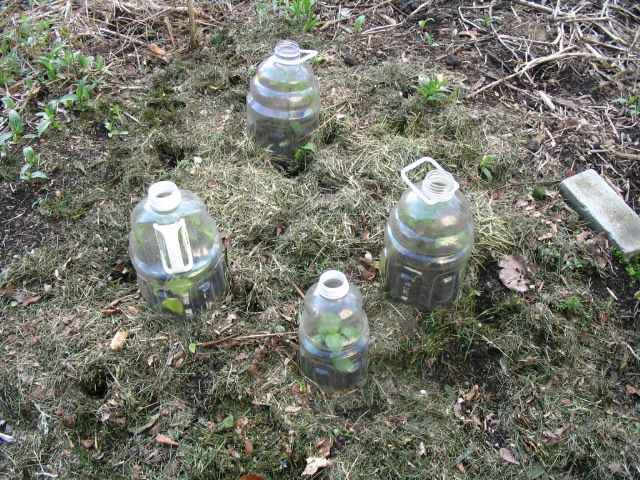
When they were planted I sprinkled a bit more water on them and sealed each plant under a cloche. The idea with the cloche is that the bottom lip has to press just a little bit into the soil to prevent a draft. If there was a place where air could get in at the base, the cloche would warm up the air and the warm air would exit through the top like a chimney thus sucking in more, colder air at the base. Don’t cram it too deeply, just enough to make bit of a seal.

I finished up by sprinkling a nice layer of grass clippings around the cloches. Yes, yes, yes – elsewhere on this blog I say why grass clippings aren’t perhaps the best mulch but, honestly, I’m also pretty pragmatic. I use what I have at hand. I’ve got other materials to put on once these clippings dissolve, as they will quite quickly, but I haven’t prepared these other materials yet.

That’s work for another day.
Posted in • Growing.

Tagged with .


Day #10 – Cranberry Cloches

Our main garden bed is a circle that we divide up into 8 “wedge” shaped beds with another smaller circle in the middle. Jan bought tomato seedling this week at the farmer’s market so now it’s time to start considering the “tomato wedge.”

Yes of course it’s too early. There are weeks left until the official “last frost day” and tomatoes seedlings in particular are very tender and more, they will just sit and glare at you, refusing to grow at all until the soil warms up. But I still want them in the ground ready to go.

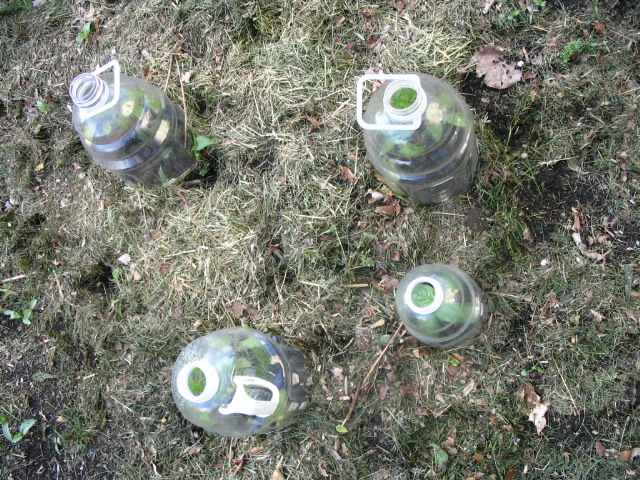
A trick we use to extend our growing season is to use “cloches” or personal sized greenhouses over our tender seedlings. The original idea of cloches, I think, dates to a style of gardening called “French intensive” gardening which is also similar to “Biodynamic” gardening. One resource for more information about these intriguing styles is: How to Grow More Vegetables in Less Space than you Though Imaginable by John Jeavons (Ten Speed Press). The first cloches were bell shaped domes of blown glass. I’ve actually seen such things for sale, but they struck me as expensive, fragile and bulky. I didn’t see what I’d do with them come fall, or honestly, how they’d survive intact ’til spring.

cloche.jpg

Instead, we have made our own very durable cloches from the 64 oz clear plastic containers that cranberry juice is often sold in simply by simply cutting off the bottom. We also have several of the 32 oz size for smaller seedlings like peppers and basil. To store them, we thread a length of rope through the necks, one by one like a string of beads. Then we tie off the ends and stow it out of the way until next year.

I have also seen a neighbor who used fishbowls! A yard full of inverted fishbowls was quite surreal.

One style of cloche that deeply intrigues me comes from the book Solar Gardening: growing Vegetables year-Round the American Intensive Way by Leandre and Gretchen Vogel Poisson. These cloches can easily be used at both ends of the harvest where mine, obviously would be too small to protect full grown plants. The “Solar Cone” as the Poisson’s call their design is also durable and furthermore, they appear to be stackable. Plus, they are elegant to look at where my recycled plastic ware most certainly is not. Some day when I have a chance I want to track down the materials to make a few.

cloche2.jpg

It didn’t take me 20 minutes to get the “snake” of cloches down from the shed but I bet it’ll take a bit longer to get the tomatoes in the ground tomorrow so I’ll bank the extra minutes.

Posted in • Making.

Tagged with .


Day #9 – Green Thumbs & Sore Backs

Do not be mistaken: gardening is work. Some gardening is even a workout.

I am not a specimen that could be described as being in “peak physical condition.” If I need to present evidence of this, let me submit the uncharacteristic aches and pains that I awoke with this morning.

Digging a new bed, for instance, is real work, obvious work, the kind of work where you crack a sweat, fill and refill a water glass, even rest with elbow on the handle of the spade from time to time to reflect on how much work you’ve accomplished… and how much more there is to be done. The style of gardening Jan and I do doesn’t call for much of this kind of work.

But even the casual work that Jan and I do requires physical exertion. There is stretching, reaching, pulling on muscles that perhaps haven’t been moved exactly like that since last year’s gardening. And that often results in these aches. It’s relatively pleasant, this kind of pain, since it’s an echo of good pleasant work.

Except when it isn’t.

If something hurts, really hurts, stop. In the least, rest up a couple days. When you start up again, go easily. If necessary, see a professional.

The weeds will still be there when you’re feeling better.

Posted in • Growing.


Day #8 – Hardware, Sharp and Noisy

I did something today I have never done before and I’m not 100% proud of it. I bought a gas-powered lawn mower. I don’t like them: they’re noisy; they’re smelly; they give off a crazy amount of emissions for the amount of work they’re performing… and they take up too much space in my precious barn.

The best solution, in my opinion would be to have no lawn at all. There are many parks around us within walking distance so if I really felt motivated to roll on some grass, I’d only need to walk a block or two. We’ve been guided by the motto: “More Hoe, Less Mow” but we haven’t entirely eliminated grass from our yard yet. Our front lawn is small and square. Our back yard has only a 3′ wide path of grass that snakes around the beds and one small snaking path of grass

For years, we tried to use –and tried to LOVE — a human-powered, rotary push mower. To be fair, it worked really quite well for our front yard. Our backyard, however, with its curved beds made the rotary push mower less effective (and made the other alternative, an electric mower almost entirely out of the question.)

And then of course there was the matter of the harvest.

The harvest? The only reason that we really tolerate much grass at all is so we can harvest the clippings and with the rotary mower, this meant raking the lawn after every cut. The clippings from an untreated lawn are a great addition to a compost. They provide nitrogen needed to break down the “brown” carbon components, like leaves. We also use some grass clippings as a mulch directly on the beds. I like them as a mulch because they are very fine textured and I can sprinkle them over seedlings in a way that I can’t with other, denser kinds of mulch. They also have a relatively attractive appearance, especially after they turn a little brown and let the green foliage stand out. A word of warning, though about adding too many grass clippings directly to your compost pile. They have a tendency to matt together and form a layer that is impenetrable to water and air. And without air, they’ll smell like cow manure. Yup. Cow manure.

So we bought that perfect suburban appliance, the lawnmower, today. If it matters, we first checked at the local repair shop to see if they had any used models in stock. Nope, it’s a busy time for them. As soon as a used one comes in, it goes out. Does it matter that we’re going to use it to cut the lawn of the 80 lady next door, because we are? Why do I still feel so darned guilty about this?

Maybe I just need to make sure that this is the LAST gas-powered lawn mower I buy, that by the time this one wears out, I’ll have a better solution.

Posted in • Growing.

Tagged with .


I Want to Live in Lee Valley

One of the few mail order catalogs whose arrival causes a stir of excitement at our house comes from the Lee Valley company. Lee Valley also offers hardware, woodworking and gifts but our biggest thrill is their gardening catalog. Practical, innovative, and beautiful objects fill their pages. It’s not fancy stuff but simply fabulous. I challenge you to flip through the catalog and not find something you must have!

compost.jpg

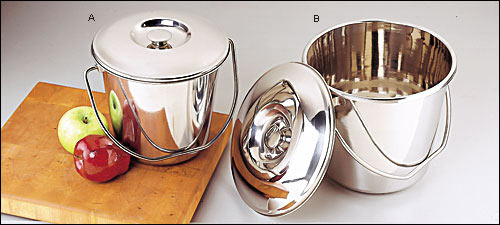
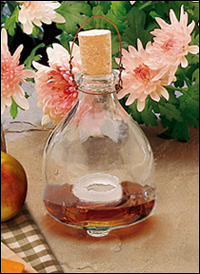
This is where we got our stainless steel kitchen compost bucket, our pound-in bed trim, our Victorian-style glass wasp trap, our disposable fruit fly traps, and lots more. More items wait on our wishlist for future orders.


wasp.jpg

The items I’ve purchased from the catalog and seen in their stores are of very good quality. When we visited the store in London, Ontario 2 summers ago, an employee told us that the company was founded by Mr Lee, who was disappointed with the quality of the tools he was able to procure. He decided to start his own company selling the best things for gardening and woodworking. I recommend them highly!

Posted in • Growing.

Tagged with , .